Every med spa owner knows the feeling: a 3:00 p.m. laser slot, prepped room, provider ready, and a patient who never walks in. Multiply that by four or five times a week and you are looking at the single largest controllable revenue leak in most aesthetic practices. The good news is that no-shows are not a personality problem with your patients. They are a systems problem with your reminders — and systems can be fixed.
This guide walks through exactly how to reduce no-shows at your med spa with automated appointment reminders, what a well-designed reminder sequence looks like, how it connects to your booking software, and how to measure whether it is working.
Why med spa no-shows happen (and why it is not the patient's fault)
Aesthetic appointments are different from a dental cleaning or a physical. They are often booked weeks out, they are frequently discretionary, and there is a meaningful share of first-time patients who booked in a moment of motivation and then got busy. Add treatment nerves, work conflicts and a lack of any real commitment mechanism, and you get the no-show rates most spas quietly live with.
The pattern we see across practices breaks down into four causes:
- They forgot. The appointment was booked three weeks ago and nothing prompted them since.
- They were unsure. They had a question about prep, downtime, or pricing and never got an answer, so they drifted.
- Life happened. They meant to reschedule but the phone tree, the voicemail, or the "we will call you back" made it easier to just not show.
- There was no skin in the game. No card on file, no confirmation, no cancellation window that felt real.
Every one of those causes has a reminder-and-follow-up fix. None of them are fixed by hoping the front desk remembers to call.
What a no-show actually costs
Before designing the fix, put a number on the problem. A mid-sized med spa running 200–300 appointments a month with a 15% no-show rate loses 30–45 visits monthly. Even at a conservative $250 average ticket, that is $7,500–$11,250 in monthly revenue that was booked and then evaporated — before counting the provider time, room prep and the downstream retention value of patients who never started a treatment series.
If you want to size it precisely for your practice, our ROI calculator walks you through the math using your own volume and ticket sizes. Most owners are surprised, and not pleasantly.
The anatomy of automated appointment reminders that actually work
Reminders fail when they are generic, single-channel and one-shot. They work when they are timed, multi-channel, interactive and connected to your calendar. Here is the sequence that consistently performs best.
1. Booking confirmation (immediately)
The moment the appointment is booked — by phone, chat, or online scheduling — the patient receives a confirmation by SMS and email with the service, provider, date, time, prep instructions and a one-tap add-to-calendar link. Confirmation is not a reminder; it is the foundation the reminders build on.
2. Seven-day reminder (email + SMS)
One week out, send a friendly reminder that leads with value: what to expect, how to prep, what to avoid (sun, retinoids, blood thinners) and a link to reschedule if needed. Offering an easy reschedule here is counterintuitive but critical — a rescheduled visit is revenue, a no-show is not.
3. Forty-eight-hour interactive confirmation (SMS)
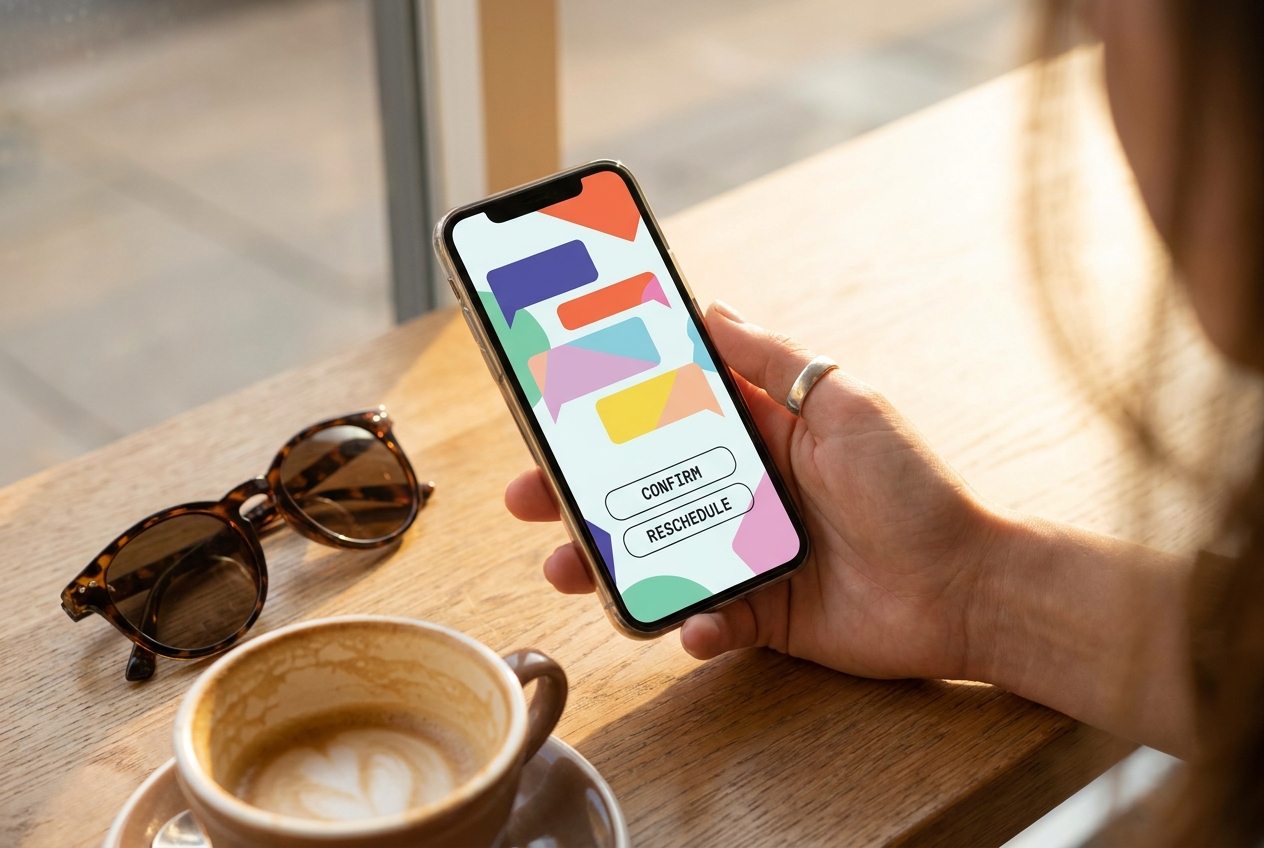
This is the highest-leverage message in the sequence. A short text asking the patient to reply C to confirm or R to reschedule. Two-way SMS turns a passive reminder into an active commitment. Patients who confirm show up at dramatically higher rates than patients who were merely notified.
4. Day-of nudge (SMS, 2–3 hours before)
A brief "See you at 2:00 today — parking is behind the building, text this number if you are running late." It catches the "I completely forgot it was today" segment and gives them a low-friction way to communicate instead of ghosting.
5. Missed appointment recovery (SMS + voice)
When someone does miss, the sequence should not end. Within 15 minutes, an automated text — and ideally an AI voice call — reaches out: "We missed you today. Want me to find another time?" Recovering even a third of no-shows into rebooked visits changes the economics of your schedule.
Why two-way, multi-channel beats a single text
A single reminder text still gets a lot of spas a modest improvement. But the sequence above works because it hits three things at once:
- Multiple channels. Some patients live in email; most live in SMS; a few need a phone call. Cross-channel delivery — the core of the HelloMedSpa ecosystem — means the reminder actually lands.
- Interactivity. Confirm/reschedule replies handled by AI chat or SMS mean the patient can act instantly instead of calling during business hours.
- Calendar integration. Every confirm, reschedule and cancellation writes back to your booking system in real time, so the front desk sees an accurate day and open slots can be backfilled from a waitlist.
The numbers: what a proper reminder sequence changes
Across practices that move from a manual or single-text approach to an automated, multi-channel sequence with two-way confirmation, the results follow a consistent shape.
No-show rate
Cancelled slots filled same day
Front-desk hours/week on reminder calls
The chart is illustrative, but the direction is what matters: no-show rate roughly halves, same-day fills go from near zero to a meaningful share of cancelled slots, and front-desk time on reminder calls drops to close to nothing because the system is doing the calling.
Beyond reminders: policies that reinforce the system
Automation carries most of the load, but a few policy choices make the reminders far more effective.
- Card on file for new patients. Not a charge — a hold. Combined with a clearly stated 24-hour cancellation window (delivered in the confirmation and the 48-hour message), it converts "maybe" into "yes."
- A real waitlist. When a patient reschedules via the 48-hour text, the freed slot should be offered automatically to waitlisted patients by SMS. This is how you turn cancellations into revenue instead of gaps.
- Deposit for high-value treatments. For laser packages, body contouring and multi-syringe injectables, a modest deposit at booking sets expectations without scaring people off.
- Consistent messaging. The tone of every reminder should sound like your best front-desk coordinator, not a robot. Warm, specific, useful.
Connecting reminders to retention
Reminders are step one. The same system that confirms this appointment should be booking the next one. After a visit, AI retention sequences follow up with aftercare, request a review through review management, and prompt the patient to book their next session in the series before the motivation fades. A patient who is reminded, shows up, and is booked for the follow-up before leaving the chair is a patient who stays.
Measuring whether it is working
Set a baseline before you switch anything on, then track four numbers weekly in your analytics dashboard:
- No-show rate (missed ÷ scheduled). Target: under 5% within 60 days.
- Confirmation rate on the 48-hour message. Target: 70%+ of patients replying.
- Recovery rate — no-shows and cancellations rebooked within 7 days. Target: 30%+.
- Front-desk minutes on reminder calls. Target: near zero.

If a number is not moving, the fix is usually in one of three places: message timing, whether the SMS is genuinely two-way, or whether the calendar integration is truly real-time.
Common mistakes when automating med spa reminders
- Reminders that cannot be replied to. A one-way blast from a "do not reply" number is a notification, not a confirmation.
- Too many messages. Five texts in 24 hours feels like spam. The five-touch sequence above is spread across a week for a reason.
- No prep content. A reminder that says "you have an appointment" is less effective than one that says "here is how to get the best result from Friday."
- Not backfilling. If reschedules and cancellations do not trigger a waitlist offer, you are only solving half the problem.
- Ignoring HIPAA. Reminder content should never include diagnosis or treatment detail beyond what is appropriate; make sure your platform meets security and HIPAA standards.
How to get started this month
You do not need to overhaul your booking stack to see results. The rollout most practices follow:
- Audit your current sequence. Write down every reminder a patient receives today, the channel, and the timing. Most spas discover they send one text and hope.
- Turn on the five-touch sequence through your med spa booking software with two-way SMS.
- Add card-on-file and cancellation language to confirmations.
- Enable missed-appointment recovery by SMS and AI voice.
- Review the four metrics weekly for the first 60 days.
To see how automated reminders, two-way SMS and calendar integration behave in practice, walk through the SMS demo and the booking calendar demo, or take the free practice assessment to find out where your schedule is leaking. When you are ready to size the opportunity for your own spa, book a strategy call — we will map your current no-show cost and the sequence that fixes it. And if you have not yet read it, our guide on how much revenue med spas lose to missed calls covers the other half of the front-desk problem.