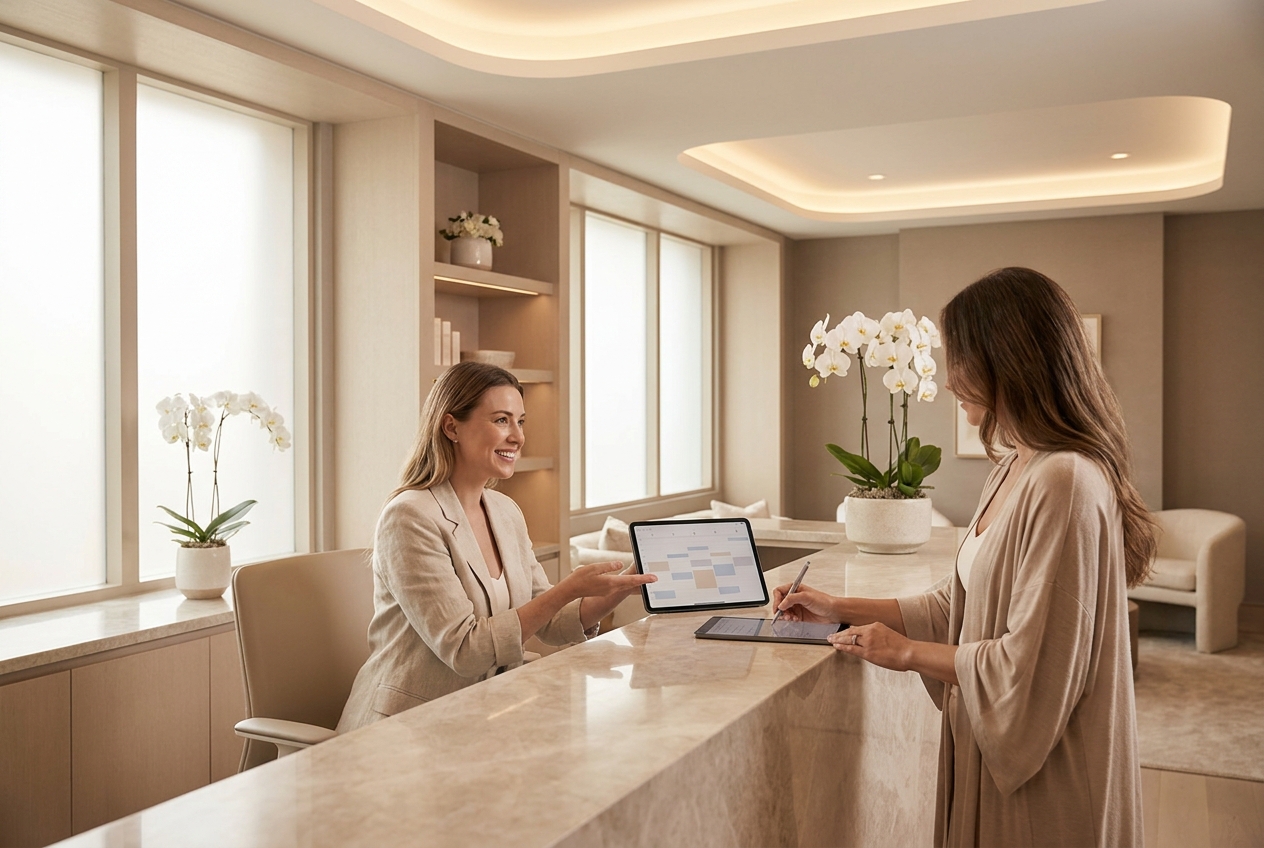
Medical spa marketing is not one channel. It is a chain: someone discovers you, decides you are credible, reaches out, gets an answer fast, books, shows up, and comes back. Most practices pour money into the first link and lose patients at the fourth and fifth. This guide covers the whole chain — what to build, in what order, and how the pieces connect.
What medical spa marketing actually includes
A complete medical spa marketing system has five parts, and they only work together:
- Visibility. Local search, your website, social proof and paid ads — how a new patient finds you at all.
- Credibility. Reviews, before-and-afters, provider credentials and a site that loads fast and answers questions.
- Capture. What happens the moment interest appears: the call, the text, the DM, the form, the after-hours inquiry.
- Conversion. Turning an inquiry into a confirmed appointment on the calendar, not a callback list.
- Retention. Rebooking, treatment series follow-through, membership and reactivation of lapsed patients.
Spending on visibility while capture and conversion leak is the most common and most expensive mistake in the industry. Fix the back half first — it is cheaper, faster and makes every future ad dollar work harder.
Start with the leak, not the funnel
Before adding a channel, measure what happens to the demand you already have. Three numbers tell you almost everything:
- Answer rate. What share of inbound calls are answered live during business hours, after hours and on weekends?
- Speed to lead. How many minutes pass between a web form, chat or DM arriving and a real reply going out?
- Booking rate. Of the people who did reach you, how many left with a scheduled appointment?
If the answer rate is below 90%, speed to lead is measured in hours, or the booking rate is under half, your marketing problem is an operations problem. We broke the math down in detail in how much revenue med spas lose to missed calls.
Local SEO: the highest-intent traffic you can get
Someone searching "botox near me" or "laser hair removal [your city]" is closer to booking than anyone who will ever see your ad. Local search is where medical spa marketing pays back fastest.
The fundamentals
- Google Business Profile. Complete every field: services, hours, booking link, attributes, service area. Post regularly. Add real photos of your space, team and results.
- Reviews, continuously. Volume, recency and response rate all matter. A steady drip of new reviews beats a burst two years ago — which is why review requests should be automated after every visit rather than left to whoever remembers. That is the job of review management.
- Service pages, one per treatment. A single "Services" page cannot rank for injectables, body contouring, laser and skin. Each major treatment deserves its own page with pricing guidance, candidacy, downtime and FAQs.
- Location pages if you have multiple sites or serve distinct metros — see how we structure areas we serve.
- Consistent NAP. Name, address and phone identical across every directory.
What most practices miss
Local rankings reward engagement signals: clicks, calls, direction requests and messages. A profile that generates calls no one answers still burns the signal — the patient bounces back to the results page and calls a competitor. Visibility and capture are the same project.
Your website's real job
A med spa site is not a brochure. It has three jobs: load fast, build trust in the first screen, and make contact effortless on a phone.
- Show real work: before-and-afters, your actual space, your actual providers.
- Put pricing in ranges. Silence on price loses more patients than a number ever will.
- Answer objections on the page: pain, downtime, results timeline, financing.
- Give three ways to act — call, text, book online — visible without scrolling on mobile.
- Add online booking that writes directly into your calendar, on the right provider and room. A form that emails the front desk is not booking.
Paid acquisition, done in the right order
Ads work when the machine behind them works. Once answer rate and booking rate are healthy, patient acquisition campaigns become the accelerator rather than a leaky bucket.
Practical guardrails:
- One offer per campaign. A specific treatment with a specific reason to act now converts better than a general brand ad.
- Send traffic to the treatment page, not the homepage.
- Track to booked revenue, not leads. Cost per lead is vanity; cost per booked, showed-up appointment is the number that matters.
- Retarget the near-misses. People who viewed a treatment page or started a booking are the cheapest patients you will ever win back.
- Respect the compliance line. No outcome guarantees, no unverifiable claims, patient photos only with documented consent.
Speed to lead: where most marketing budgets die
Aesthetic patients shop. When someone submits a form at 8:40 p.m., they are usually messaging two or three other practices in the same sitting. The one that answers first, with a real answer, usually wins.
This is a staffing impossibility and a software problem. A front desk cannot cover evenings, weekends, lunch rushes and treatment-room chaos. A 24/7 AI receptionist answering every call and an AI chat assistant handling web chat, SMS and social messages closes that window to seconds — answering pricing and prep questions, then booking into the calendar. The HelloMedSpa AI Front Desk Receptionist starts at $500 per month, which is why it is usually the first thing we turn on.
Retention is the cheapest growth channel you own
Acquiring a new aesthetic patient costs many times more than rebooking an existing one, and most treatments are naturally recurring: neurotoxin every three to four months, laser in series, facials monthly, body contouring in packages.
A retention system should, without anyone remembering to:
- Send aftercare on the correct schedule for the treatment.
- Prompt rebooking before the patient leaves — and again at the right interval if they did not.
- Reactivate lapsed patients with a relevant reason, not a generic blast.
- Promote memberships and packages to the patients most likely to say yes.
That is what patient retention automation is for, and it is the single highest-return line item in most medical spa marketing budgets.
Reviews and reputation as a growth engine
Reviews influence both ranking and the decision itself. Automate the ask at the moment satisfaction peaks — right after a good visit — route unhappy feedback privately to the owner first, and reply to every public review. Consistency here compounds; campaigns here do not.
The connective tissue: one system, not eight tools
The reason most of this fails in practice is fragmentation. Ads live in one platform, the phone in another, chat in a third, the calendar in a fourth, and no one can tell which channel produced a booked patient. Nothing follows the patient across channels, so the same person explains themselves three times.
A unified ecosystem fixes that: every channel writes to one patient record, so the AI answering tonight's text already knows she called yesterday about laser pricing and has an appointment Thursday. You can see each channel working in the interactive demos.
A 90-day medical spa marketing plan
Days 1–30 — stop the leak. Measure answer rate, speed to lead and booking rate. Turn on 24/7 call, chat and text coverage. Get online booking writing into your calendar. Automate review requests.
Days 31–60 — build visibility. Complete the Google Business Profile, publish one page per major treatment, add real photos and before-and-afters, publish pricing ranges, and fix mobile speed.
Days 61–90 — accelerate. Launch one focused paid campaign per priority treatment with retargeting, switch reporting to cost per booked appointment, and turn on rebooking and reactivation sequences.
How to measure it
Track weekly, not quarterly: answer rate, average speed to lead, inquiry-to-booking rate, no-show rate, rebooking rate, reviews added, and revenue per booked appointment by channel. If a channel cannot be tied to booked revenue, you cannot manage it — and you should not scale it. Our pricing page outlines what is included at each tier as you expand coverage.
The bottom line
Medical spa marketing is not about doing more channels. It is about making sure that every patient who already wants you can reach you instantly, book without friction, and be brought back automatically. Fix capture and conversion first, then buy attention. Results vary by practice, but the order of operations rarely does.
Want to see where your chain is leaking? Book a strategy call and we will walk your numbers with you.